Turtles in Turtle Bay, Cyprus: Where to Find Them Around Cape Greco and Protaras
Sea turtles are one of the reasons people fly to Cyprus. We've been running turtle cruises out of Ayia Napa Harbour for years now, and the area around Konnos Bay — often called Turtle Bay by tour operators — is where most of our turtle encounters happen. Green Bay in Protaras and the waters around Blue Lagoon also produce regular sightings. This guide walks through where the turtles actually live, when they're most active, which species you're likely to meet, and how to see them, whether you're booking a cruise or going in with a mask from the shore.
If you've spent any time researching turtle tours in Cyprus, you've probably noticed every operator claims the same thing: high success rates, beautiful bays, professional crew. The reality is more uneven than the brochures suggest. What follows is what we've actually learned from running this route, including the parts that don't make it into the marketing.

Turtle Species You'll Meet Around Cyprus
Two species are common in the waters around Ayia Napa and Protaras, and knowing the difference makes the experience richer when you actually see one.
Green Turtles (Chelonia mydas)
The species you're most likely to see on our cruises. Greens are herbivores and spend long stretches grazing on seagrass beds, which makes them easier to spot and photograph than turtles that are constantly on the move. Adults reach around 1 to 1.2 metres in shell length and 130–160 kg, though most we see in the bays are juveniles, somewhat smaller. The name comes from the colour of their body fat, not the shell, which is usually olive or brown. How to recognise one:- Smaller, more rounded head relative to the body
- A single pair of scales between the eyes
- Serrated lower jaw — built for cutting seagrass
- Slow, methodical movement along the seabed
Loggerhead Turtles (Caretta caretta)
Bigger, broader, and the species that nests on Cyprus beaches in summer — Lara Bay in the west and parts of the Akamas Peninsula are protected nesting sites. You'll spot loggerheads in the water year-round, usually moving with more purpose than the greens. Adults can reach 90–100 cm in shell length and weigh up to 135 kg. How to recognise one:- Larger, blockier head with a powerful jaw (they eat crabs, jellyfish, and shellfish)
- Reddish-brown shell and skin
- More active behaviour — usually swimming rather than grazing
- Completely harmless to swimmers, despite the size
Where We Actually Find Them
Cyprus has plenty of coastline, but turtles aren't evenly spread along it. After years of running this route, the spots that consistently produce sightings are the bays in the Konnos Bay area and the seagrass beds near Green Bay in Protaras. Blue Lagoon also produces regular loggerhead sightings, particularly in the morning before the bay gets busy with boats. Our cruise anchors at Blue Lagoon and the Konnos area; Green Bay is on the coastline route, but we don't anchor there — it's better for guests with their own gear who want to swim out from shore.
Konnos Bay Area (Also Called Turtle Bay)
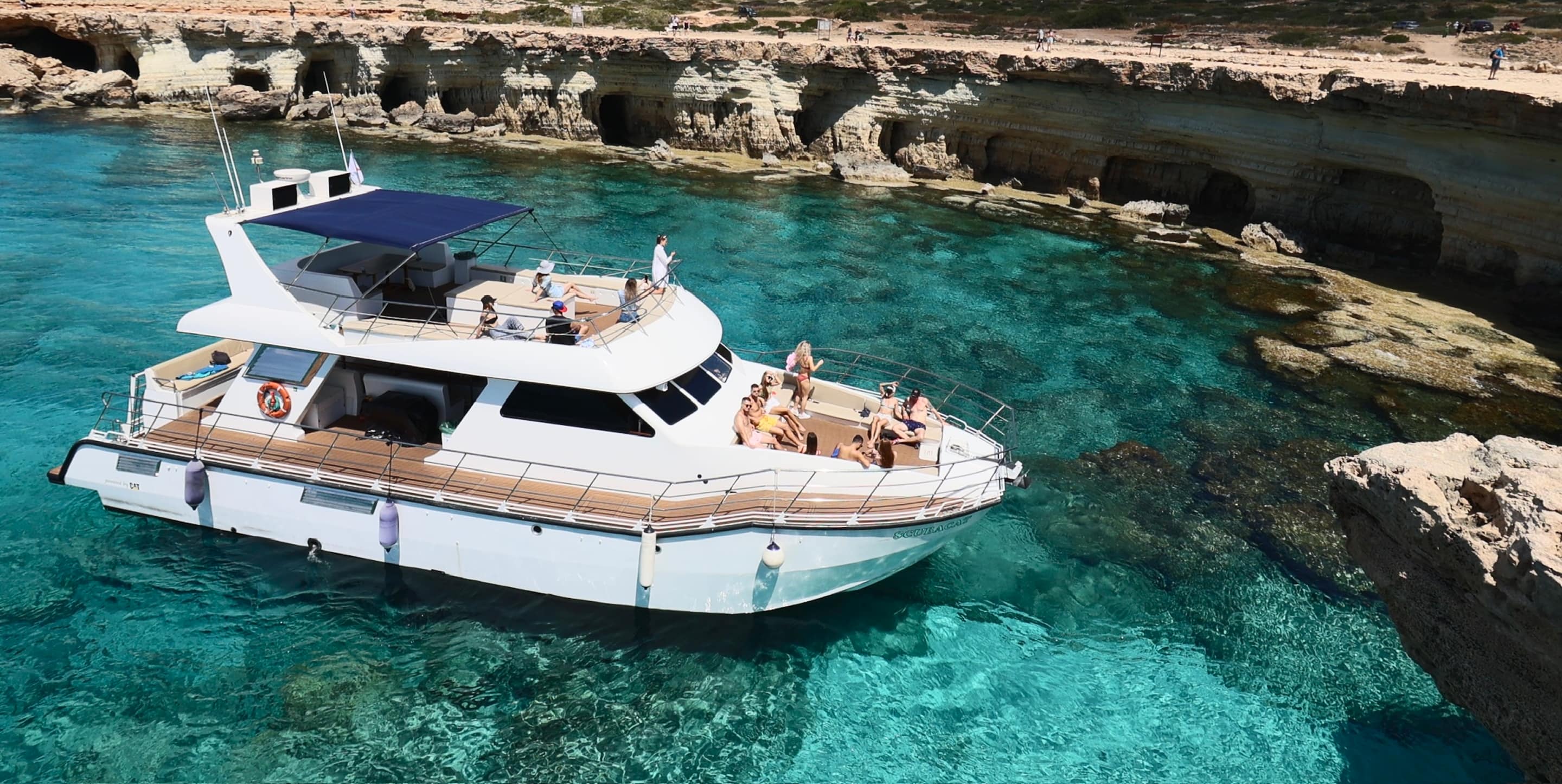
Konnos Bay sits inside Cape Greco National Forest Park — a horseshoe of pale rock with calm water in the middle, sheltered from the prevailing wind and with seagrass on parts of the seabed for greens to graze. Tour operators often refer to the wider area around Konnos as "Turtle Bay" or "Turtle Cove", since this stretch produces the bulk of sea turtle encounters on the southeast coast. The names overlap and aren't entirely consistent across operators, but Konnos is the formal name of the bay itself. This is our first and main turtle stop on the morning cruise. We anchor here for around an hour — long enough for swimming and unhurried turtle spotting. You can spot turtles from the deck on a calm day, but most guests prefer to get in the water with a mask and meet them properly. Visibility is consistently good because there's no river runoff and the seabed is mostly rock and seagrass rather than sand. The BBQ is cooked and served afterwards, as we cruise from here toward Protaras. If you're not on a cruise, Konnos Bay is also accessible from shore — there's a beach and parking, and you can swim out with your own gear. Just be aware that the bay gets busy after 10 am in summer; earlier is quieter and the water clearer.Blue Lagoon: The Bonus Turtle Spot
Blue Lagoon isn't primarily known as turtle territory — it's known for its extraordinary turquoise colour and 20–30 metre underwater visibility. But loggerhead turtles do turn up here, particularly on morning trips before the bay fills with boats. They come to feed in the calm clear water, and the visibility makes spotting them from the surface or the boat deck easier than almost anywhere else on the route. Our morning cruise anchors at Blue Lagoon for around an hour as the second swim stop, on the way back from the Konnos Bay area. Even when turtles don't show up here, the water itself is the reason most people remember the day.Green Bay: Best for Independent Swimmers
Green Bay sits in Protaras, between Fig Tree Bay and Konnos Beach. It's better known among snorkellers and beginner divers than among regular beachgoers — shallow water, easy walk-in entry from a rocky shoreline, and visibility usually clear to the seabed. The bay is sheltered from the prevailing wind and stays calm on most mornings.
For turtle spotting, Green Bay works because of the seagrass meadows on the seabed. Green turtles graze there regularly, and a quiet morning swim with a mask is often enough to spot one without going deep. We can't promise a sighting on any single day — turtles are wild, and they don't follow anyone's schedule — but Green Bay is on the short list of reliable spots on Cyprus's southeast coast.
Worth knowing if you're considering Green Bay: it's not a cruise stop on our route. The bay is best reached from shore — there's parking nearby, and you can walk in with your own gear or rent it from local dive shops. If you want a turtle encounter without booking a cruise, Green Bay is one of the easiest ways to do it.
What makes Green Bay work:
-
Protected from wind and currents on most mornings
-
Long seagrass meadows that green turtles graze on
-
Visibility usually to 5–10 metres
-
Easy snorkelling depth, so most swimmers can spot turtles without diving down
-
Accessible from shore, no boat needed
Best time to visit: early morning, ideally between 8 and 10 am. The water's flattest, visibility's at its best, and the turtles are still actively feeding from the night.


Swimming with Sea Turtles Around Protaras
If you've never swum near a sea turtle, manage your expectations: this isn't a dolphin show. Turtles are calm, slow, and unbothered by swimmers who don't make a fuss. That's the appeal. You're not interacting with them — you're sharing their space for a few minutes while they go about their business.
What you'll typically see:- Green turtles grazing on seagrass, moving slowly along the seabed, surfacing every 4–7 minutes for a breath
- Loggerheads swim higher in the water column, surfacing more often
- Occasionally, a turtle that's mildly curious about a swimmer drifts a little closer before carrying on
Departing from Ayia Napa: How the Route Works
We typically leave from Ayia Napa Harbour at 9:30 am and return at 2:00 pm — a 4.5-hour loop. Exact departure time can shift slightly through the season — check when booking. The route runs along the southeastern coast — out past the Ayia Napa Caves, Love Bridge, the Sea Caves at Cape Greco, the lighthouse, and Royal Bay, then on to the Konnos Bay area for the first swim stop (around an hour), where most of our turtle encounters happen. The BBQ is cooked and served as we cruise from there toward Protaras, with a second swim stop at Blue Lagoon on the way back. From there, we continue along the coast past Green Bay and Fig Tree Bay to Protaras, then turn back toward Ayia Napa Harbour — we don't go further toward Famagusta. The crew adjusts the route in the morning based on wind direction and how busy the bays are. Ayia Napa Harbour itself is straightforward — parking is easy outside peak hours, there are cafes nearby if you arrive early, and the boarding ramp makes getting on the catamaran simple. Protaras-based guests have a 15-minute drive over; we tell people to leave 30 minutes early in summer because the coastal road backs up.Timing: When Turtles Are Most Active
Turtles are in Cypriot waters all year, but the season runs from April to October for swimming. Inside that window, some periods work better than others.
- Peak months (June–September): Warmest water (24–28°C), longest days, most reliable sightings. Also, the busiest in the bays — book ahead.
- Shoulder months (May, October, and into November): Fewer crowds, slightly cooler water, sighting rates still solid. A good compromise if you'd rather not share Konnos Bay with three other boats.
- Out of season (deep winter): We don't run cruises in the coldest months. Water's too cold, the weather is unpredictable, and the turtles are deeper and less visible anyway.


How We Run Trips Around Wildlife
Sea turtles are protected under both Cyprus and EU law, and beyond the legal side, watching the same turtles year after year tends to make you protective of them. A few rules we hold firm on:
- Keep your distance. No chasing, no touching, no feeding. If a turtle approaches you, hold still — it'll move on when it's done. The approach distance we recommend is 3 metres minimum.
- No flash photography. Underwater flashes startle them and can disrupt feeding. Daylight is plenty in these waters.
- Move calmly in the water. Slow fin kicks, no splashing. The turtles tolerate respectful swimmers; they leave when people thrash around.
- Reef-safe sunscreen if you have it. Standard sunscreens contain chemicals (oxybenzone, octinoxate) that damage marine ecosystems. If you didn't bring any, we'd rather you skipped a top-up than added more chemicals to the water.
- Stay with the group. The crew watches the water; lone swimmers wandering off make it harder to do that.
What's Provided and What to Bring
Snorkelling masks are provided on board for all guests, against a refundable cash deposit of €20 per mask. The deposit is returned when you hand the mask back at the end of the cruise — we use proper-quality masks rather than the cheap kind, so the deposit covers us if one is lost.
Please bring €20 in cash if you'd like to use a mask; cards aren't accepted for the deposit. Your own mask is welcome, no deposit needed. Life jackets are on board for anyone who wants one, and there's freshwater on tap for rinsing salt off after a swim. What to pack:- Swimwear and a towel
- Sunscreen (more than you think you need — the reflection off the water doubles it)
- Hat and sunglasses with a strap (we've fished a lot of sunglasses out of the bay)
- A waterproof case or pouch for your phone if you want to take photos in the water
- A light layer for the boat ride back, if you burn easily
- €20 in cash for the mask deposit, if you want to use one of ours
- Cash or card for the onboard bar (drinks aren't included in the cruise price)
FAQs
Where can I actually see turtles in Cyprus?
The most reliable spots on the southeast coast are the Konnos Bay area (often called Turtle Bay), Blue Lagoon, and Green Bay in Protaras. The first two are stops on our morning cruise; Green Bay is best reached from shore if you have your own snorkelling gear.Is swimming with turtles safe on a SCUBACAT cruise?
Yes, as long as you follow the briefing: keep your distance, no touching, no chasing. The turtles aren't aggressive; the risk on these trips is people, not the wildlife. We've run hundreds of trips without a wildlife-related incident.What's the best time of year to come?
April to October for swimming conditions. June to September is the peak for warm water and active turtles; May and November trade some warmth for thinner crowds and easier booking.Are turtle sightings guaranteed?
No — and anyone telling you otherwise isn't being straight with you. Our sighting rate sits above 90% across the season, which is high, but turtles are wild animals, and we can't promise their attendance. What we can promise is that we know the spots, we time the trips well, and on the rare day they don't show up, the swim stops, and the coastline still makes the day worthwhile.What should I bring?
Swimwear, towel, sunscreen, hat, sunglasses, and a waterproof phone case if you want underwater photos. €20 in cash if you'd like to borrow a snorkelling mask (refundable deposit, cards not accepted). Your own mask is welcome instead, no deposit needed.What if the weather's bad?
We cancel and reschedule, or refund — your choice. We don't run if conditions would compromise either safety or the experience. Cyprus's weather is generally reliable through the season, but the occasional summer storm does happen.