Must-See Spots Around Ayia Napa — and How to See Them from the Water
If you're planning a trip to Ayia Napa, you've probably already got a mental list of the famous spots: Cape Greco, Love Bridge, the Sea Caves, the Blue Lagoon. They're on every Cyprus guide for a reason — the southeastern coast of the island has one of the most photographed stretches of coastline in the Mediterranean, and most of it is concentrated in a half-hour drive from Ayia Napa town centre.
This guide walks through the must-see spots — what they actually are, what's worth visiting, and (the part most guides miss) which ones look completely different from the sea than they do from the cliff path. We run boat trips, so we're going to mention how the cruise route covers some of these places. But the goal of this page is the guide itself: even if you never set foot on our catamaran, you'll know what to see and how to plan around it.

The Coastline Spots: What You Came to Cyprus to See
Most of Ayia Napa's famous photo spots are along the coast east of town, stretching toward Cape Greco. They're all reachable by car, bus, or a long coastal walk — and most are also passed by boat trips from the harbour, with the sea giving you an entirely different angle on the same formations.
Cape Greco National Forest Park
The starting point for almost everyone's Ayia Napa must-see list. Cape Greco is a 385-hectare protected park covering the rocky peninsula between Ayia Napa and Protaras. Inside it: hiking trails, dramatic limestone cliffs, sea caves, the Love Bridge, a lighthouse, the chapel of Agioi Anargyroi, and panoramic viewpoints over the eastern Mediterranean.- Best for: Hiking, photography, sunset views, picnics, watching dolphins from the cliffs (yes, really — it happens).
- How to visit by land: Park at the visitor centre or one of the marked lots along the coastal road. Trails range from 10-minute strolls to multi-hour loops. Bring water and proper shoes — the paths are rocky.
- How you see it from the sea: This is the centrepiece of most Ayia Napa boat trips. Our morning cruise route follows the cape's coastline from Ayia Napa Harbour all the way around to Protaras, passing every major landmark inside the park from the water. You see the cliffs from below — a perspective that's harder to appreciate from the trails above.
Love Bridge
A natural limestone arch jutting out over the sea, closer to the Ayia Napa side of the Cape Greco coastline. Couples come here for the views and the photos — there's a long-running tradition of stopping at the arch for engagement shots, wedding photos, and the obligatory wish on the bridge.- How to visit by land: Marked turn-off on the coastal road. Small car park nearby, short walk to the viewpoint.
- How you see it from the sea: From the water, you see the Love Bridge from below — the arch silhouetted against the sky with the open sea behind it. The cliff path gives you the arch from one side; the boat route gives you the whole structure with the sea wrapping around it.
Kamara Tou Koraka (Crow's Arch)
A second, larger natural arch further along the Cape Greco coastline, closer to the Protaras side — near the small chapel of Agioi Anargyroi. It's the biggest natural rock arch in Cyprus, and one of the most photographed.- Important to know: Kamara Tou Koraka is fenced off by the Department of Forests due to a visible crack in the structure and ongoing erosion that puts it at risk of collapse. You can still walk to the viewing area and see the arch clearly, but you can't walk across it. Don't hop the fence — beyond the obvious safety risk, there are fines for unauthorised access. More on the closure and how to still see it from the water.
- How to visit by land: Follow the coastal road inside Cape Greco park toward the chapel of Agioi Anargyroi. Small parking nearby, short walk to the viewing area.
- How you see it from the sea: Boats passing this stretch of the coastline see the arch from below, with the open sea behind it. From the water, you get the full scale of the structure — much harder to appreciate from the cliff path, where you only see one side.


Ayia Napa Sea Caves
A network of natural limestone caves carved into the cliffs east of Ayia Napa town. The caves extend up to 80 metres underground, partially submerged, with the upper sections open to walk through and the lower sections accessible by sea. This used to be the most popular cliff-jumping spot in Cyprus — until recent safety closures.- Important to know: The main cliff-jumping section is now fenced off. You can still walk to the viewpoint and see the formations clearly from a safe distance, but jumping from the cliffs is no longer permitted.
- Best for: Photography from the cliff path, swimming in the calm water below the cave entrances (from the sea, not by jumping), exploring the cave interiors at low tide.
- How to visit by land: Turn off the Cape Greco road onto a dirt track that leads to the cliff edge. About 10 minutes' drive from central Ayia Napa, or accessible by the 101/102 bus from the main road.
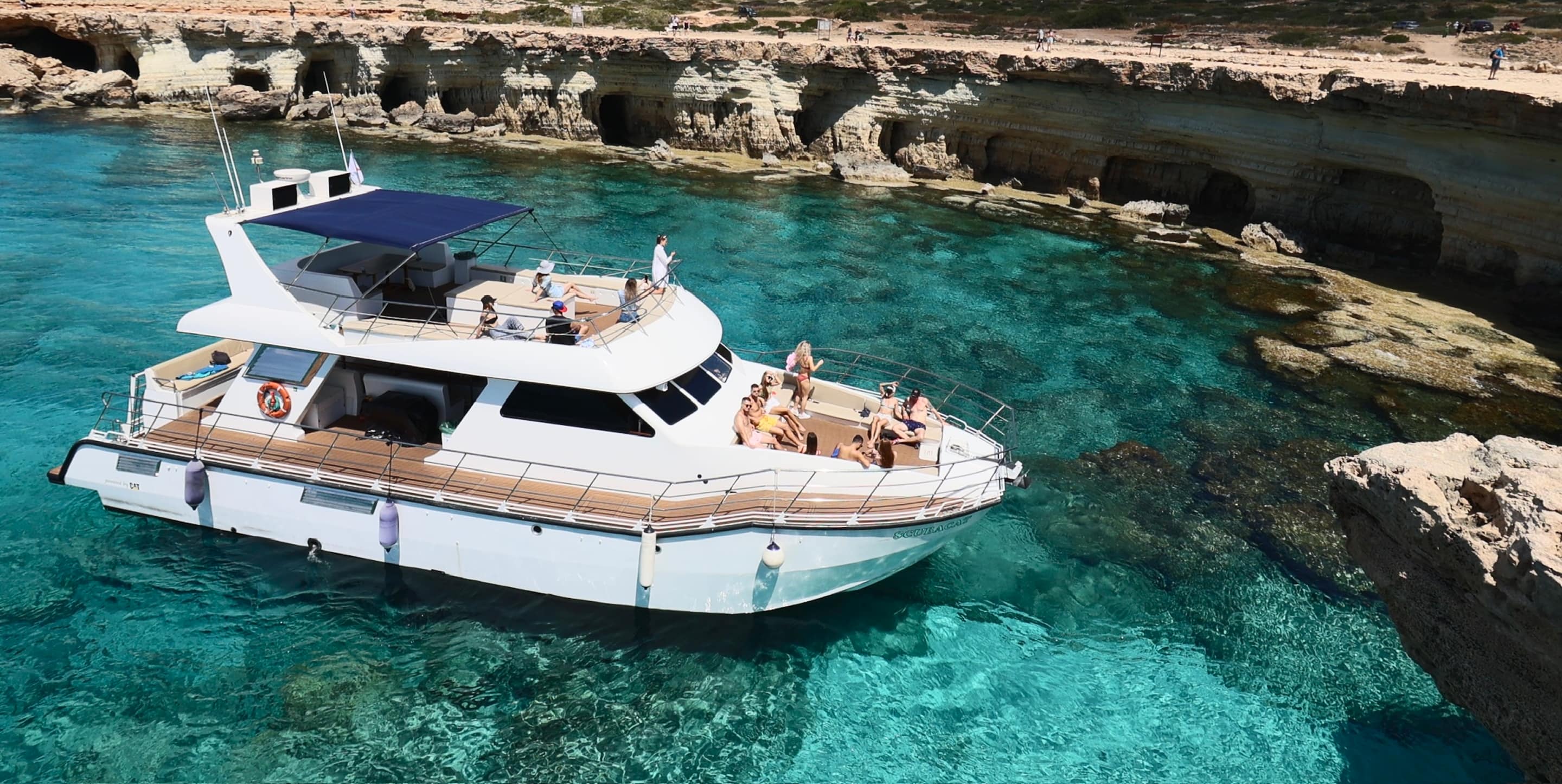
- How you see it from the sea: Boats can move close to the cave mouths and into some of the shallower openings. You get to see the caves from inside, looking up at the limestone formations instead of down on them. The mushroom-shaped rock formation above the caves is far more dramatic from the water than from the cliff path.
Blue Lagoon
A small sheltered bay on the Cape Greco coastline, famous for its luminous turquoise water and visibility that regularly reaches 20–30 metres. The colour comes from a white limestone seabed combined with shallow, clear water — it's a real optical effect, not photo filtering.- Best for: Swimming, snorkelling, photography. There's no beach — entry is over rocks or directly off a boat.
- How to visit by land: Technically possible by a steep walk down from the Cape Greco cliff path, but the descent is rocky and not practical with swimming gear. Most visitors arrive by boat.
- How you see it from the sea: This is the realistic way to experience Blue Lagoon. Boat trips from Ayia Napa Harbour anchor in the bay for around an hour, with swim deck access and the swimmers' view of one of the clearest pieces of water in the Mediterranean. Our morning cruise stops here as the second swim stop on the way back.
Konnos Bay
A horseshoe-shaped bay inside Cape Greco park, with calm water and a sandy seabed in the middle. Sheltered from the prevailing wind, with seagrass meadows along parts of the seabed where green turtles graze. Tour operators often call the wider area around Konnos "Turtle Bay" — sea turtles are spotted here regularly.- Best for: Family swimming (calm water, gentle entry), turtle spotting with a mask, picnics on the beach. There's parking, a small beach club, and shade.
- How to visit by land: Marked road inside Cape Greco park, easy to find. Gets busy after 10 am in summer.
- How you see it from the sea: Our morning cruise anchors in the Konnos area as the first swim stop — turtle spotting happens here, and this is where the BBQ is fired up before we cruise toward Protaras. From the water, you can swim into parts of the bay that aren't reachable from the shore.
Cape Greco Lighthouse
A small white lighthouse at the southernmost tip of the cape. Not open to the public (it's an active navigation aid behind a fence), but the surrounding area has some of the most dramatic cliffs and viewpoints in the park.- Best for: Sunrise photography, sweeping views, hiking. Often quieter than the more famous viewpoints because most visitors don't realise it's there.
- How to visit by land: Walk or drive to the end of the road inside Cape Greco park.
- How you see it from the sea: Boat routes pass directly below the lighthouse on the way around the cape — the cliffs here are some of the most photogenic from the water.


The Town and Inland Spots: Worth Visiting Beyond the Coastline
Ayia Napa isn't only about the cliffs. A few spots in town and inland are worth half a day each.
Ayia Napa Monastery
A 16th-century stone monastery in the heart of Ayia Napa town. Peaceful, free to enter, surrounded by gardens and an old sycamore tree said to be 600 years old. It's a surprising find right in the middle of the town's restaurant and nightlife area — proof that Ayia Napa was a quiet village long before the resorts arrived.- Best for: A 30-minute break from the beach, photography, anyone interested in Cypriot Orthodox heritage.
Sculpture Park (Ayia Napa Sculpture and Cactus Park)
A free open-air park east of town, with over 200 large-scale contemporary sculptures from international artists, plus a botanical garden of cacti and Mediterranean plants. Sits on a hill with sweeping views over the coast. Best at sunset.- Best for: A different kind of walk, photography, families. Easily combined with a visit to nearby Cape Greco.
MUSAN — Museum of Underwater Sculpture Ayia Napa
An underwater sculpture park off the coast near Pernera Beach. Over 90 sculptures by British artist Jason deCaires Taylor are placed on the seabed at around 10 metres depth, designed to encourage marine life regeneration. Accessible only by snorkelling or diving.- Best for: Snorkellers, divers, anyone looking for something unusual. Multiple dive operators run guided MUSAN tours.
Nissi Beach
The most famous beach in Ayia Napa — fine white sand, shallow turquoise water, a small islet you can wade to. Crowded in peak season, but worth a visit at least once. Less photogenic than Blue Lagoon but far more accessible (no boat or long walk required).- Best for: Easy beach days, families with young kids, swimmers who want shallow water.