Best Turtle Cruise in Cyprus: How to Pick One That Actually Delivers
If you've spent half an hour browsing turtle cruises in Cyprus, you've probably noticed they all sound the same on paper. Every operator promises high sighting rates, beautiful bays, professional crew. The reality is more uneven — some run packed boats with long queues for the snorkel masks, others run smaller trips with food cooked on board. This page is an honest guide to what actually matters when comparing turtle cruises in Ayia Napa and Protaras, written by people who've been running this route for years and have a strong opinion about it.
We'll cover what to look for, what to avoid, and where SCUBACAT fits in the picture. We're not going to pretend we're the right choice for everyone — we're not. But we are going to tell you straight what separates a good turtle cruise from a forgettable one. The basics first: our route loops from Ayia Napa Harbour past the sea caves, with two main swim stops — the Konnos Bay area (sometimes called Turtle Bay) first, then Blue Lagoon on the way back. BBQ is cooked and served on board between the two swims. Most days we see turtles; some days we don't.

What Actually Separates Cruises in Cyprus
Comparing turtle cruises by price alone is a mistake — sticker prices can be misleading, and what's actually included varies a lot. Here's what to look at instead.
Hull Type and How the Day Is Paced
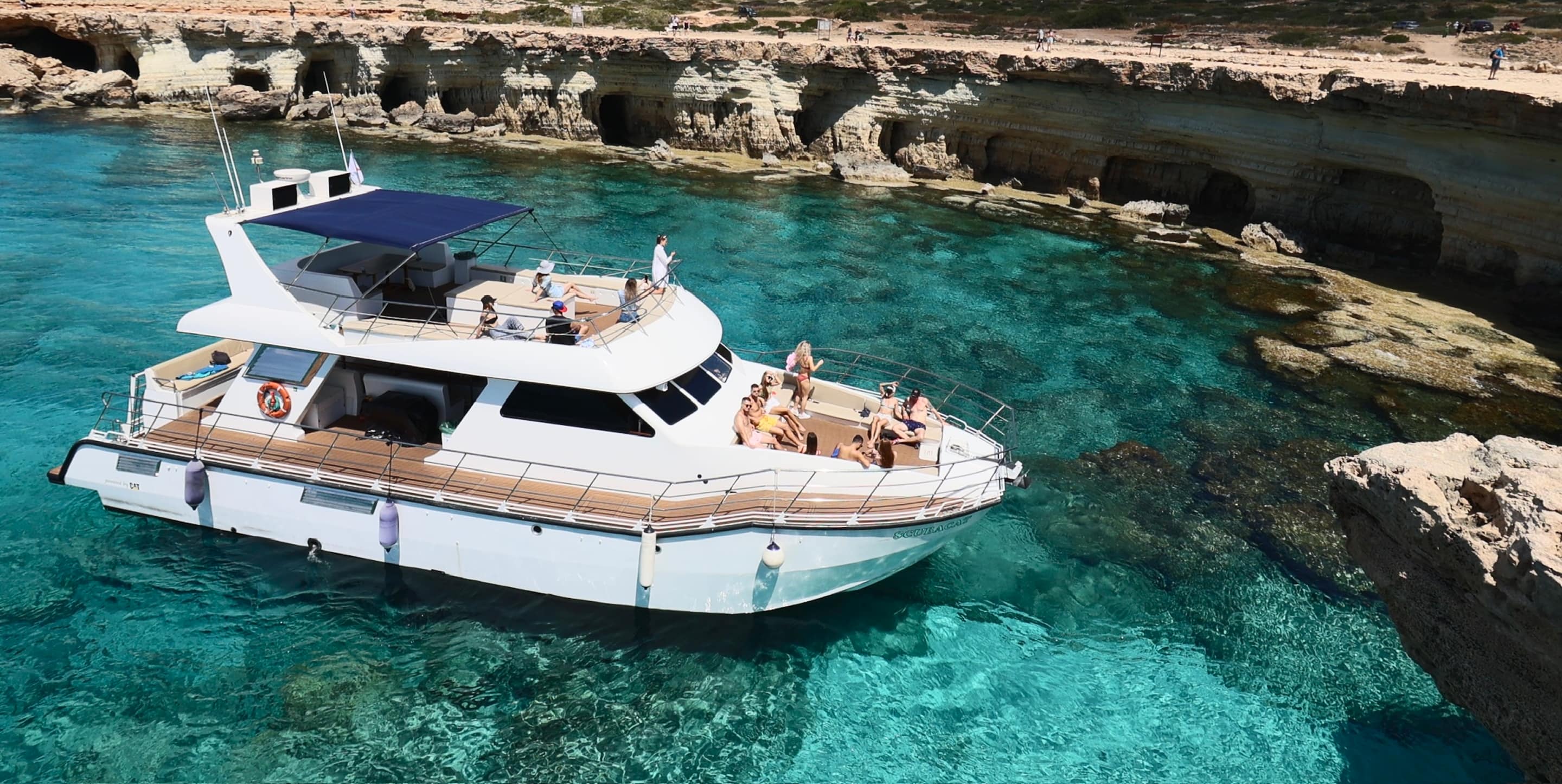
Boat design matters more than most people realise when booking. The single biggest factor is hull type. Catamarans hold a specific advantage on the Cyprus coast: the twin-hull design stays stable in light chop and doesn't roll at anchor, which matters if anyone in your group gets queasy — and matters again when you're climbing on and off a swim ladder repeatedly. Traditional monohulls roll more, especially anchored. The other practical advantage is the draft. Catamarans sit higher in the water, so they can anchor closer into the shallow, sheltered parts of bays, which is exactly where turtles graze. A deeper-hulled boat has to stay further out, which means a longer swim to reach the spots where turtles actually are. Group size is a separate question from boat type, and the honest answer is that bigger isn't automatically worse. What matters is the ratio of crew and space to passengers, how the day is paced, and whether the operator sticks to the advertised headcount. Some operators take on more passengers than their listings suggest, which is when a boat starts to feel cramped. A well-run catamaran with shade, room to move, and an unhurried schedule beats a packed monohull on a tight timetable.Where the Boat Actually Goes
Some cruises spend half the trip transiting up and down the coast, ticking off scenic stops without spending real time at any of them. Others anchor at three or four spots and let you swim properly. The question to ask before booking is: how long do we actually spend at each swim stop? Around Cape Greco, the spots that consistently produce turtle sightings are the bays on the Konnos side (often referred to collectively as Turtle Bay or Turtle Cove by tour operators) and the seagrass beds around Green Bay near Protaras. A cruise that anchors at one of these for a proper hour, rather than swinging past for 10 minutes between coastline stops, is set up for actual turtle encounters. Ours anchors in the Konnos Bay area for around an hour as the first swim stop of the day — long enough for swimming and turtle spotting without rushing. The BBQ is served afterwards, as we cruise toward Protaras.Read the Small Print
The price you see in a listing isn't always the price you pay. A few patterns worth checking before you book:- What "lunch included" actually means. Sometimes it's a freshly cooked meal, sometimes pre-packed sandwiches, sometimes an "optional" add-on you only hear about once you're on board. Look for specifics in the description.
- Drinks. Some cruises don't include drinks beyond water in the ticket price — there's usually a bar on board. That's normal; just budget for it.
- Photo packages. Mid-cruise upsells (a crew member with a GoPro, photos available at disembarkation for an extra fee) are common. Not predatory — the photos are usually good — but a budget line nobody plans for.
Ayia Napa vs Protaras Departure
Both Ayia Napa and Protaras have boat departures, and Protaras is geographically a bit closer to Cape Greco — but the more important difference is the route. Cruises leaving from Protaras head out in the opposite direction from Ayia Napa, which means they miss the stretch of coastline most people actually came to see: the Ayia Napa Caves, Love Bridge, the Sea Caves at Cape Greco, and the lighthouse. Our route from Ayia Napa Harbour passes all of these on the way out before reaching the swim stops. If your hotel is in Protaras, the 15-minute drive to Ayia Napa Harbour is usually worth it for the route alone. We have plenty of guests who make that trip every morning we run.

Red Flags Worth Watching For
After years of watching this market, here are the patterns we see in cruises that disappoint guests:
- Vague descriptions of food and gear. "Lunch included" without specifics — sometimes that's a freshly cooked meal, sometimes pre-packed sandwiches. Same with masks: some operators hand out cheap souvenir-shop snorkels, others use proper-quality gear (which is usually why there's a small deposit). The detail-light listings are the ones most likely to surprise you on board.
- More passengers than the headcount suggested. A boat listed for "small groups" that turns out to be packed. Real reviews tell you more about this than the marketing photos.
- No mention of cancellation policy. Cyprus's weather is generally reliable, but storms happen. Operators without a clear refund or reschedule policy can leave you out of pocket.
What "90% Sighting Rate" Actually Means
You'll see this figure quoted by almost every turtle cruise operator in Cyprus, including us. We want to be honest about what it does and doesn't mean.
For us, it means roughly 9 out of 10 morning trips end with at least one turtle sighting somewhere on the route. We track this loosely — it's not a precise scientific number, and it varies by month and conditions. Other operators may track it differently or not at all. The figure is widely used because it's roughly accurate for the Cape Greco coastline in general, not because any particular operator has a magic formula. What no operator should claim, and what we don't claim, is that sightings are guaranteed. Sea turtles are wild animals. They don't follow boat schedules. On a bad day, they're deeper, less active, or just somewhere we're not. Our sighting rate is high because we know the spots and times of the trips well, not because we've trained the turtles to show up. The honest takeaway: any cruise around Cape Greco at the right time of year has a strong chance of producing a turtle encounter. The differences between operators are more about what happens on the rest of the day — the food, the swim time, the crew, the boat — than about whether you'll see a turtle at all.When to Book: Season and Time of Day
Turtles are in Cypriot waters from April through the autumn. Inside that window:
- June to September is peak — warmest water (24–28°C), most active turtles, but also the busiest in the bays. Book a week or more in advance for weekend mornings.
- May, October, and into November are quieter, with cooler water and thinner crowds. Sighting rates stay solid. A good window if you'd rather not share the Konnos area with three other boats.


Where SCUBACAT Fits
Where we work well:
- Families on holiday looking for a real day out together
- Couples and groups of friends in their 20s–40s who want a proper experience, not a quick photo stop
- People who care about the food side — the onboard BBQ is genuinely one of the things guests remember most
- Anyone who wants a catamaran specifically — stable at anchor, wide decks, shade, and no monohull roll
- Travellers prone to seasickness — the catamaran's stability is noticeable
- Strict budget travellers who want the cheapest possible ticket
- Large private groups looking for an exclusive charter — we're a shared-cruise operation
- Travellers who specifically want a quiet, no-music, contemplative trip — our morning cruise has a livelier vibe
What's Included in the €45
- 4.5-hour catamaran cruise (typically 9:30 am — 2:00 pm; departure time can shift seasonally)
- Coastline route: Agia Napa Caves, Love Bridge, Sea Caves, Cape Greco, lighthouse, Royal Bay, Protaras
- Swim stop in the Konnos Bay area with turtle spotting (around an hour, first stop)
- Swim stop at Blue Lagoon (around an hour, on the way back)
- BBQ lunch cooked and served on board between the two swims, with vegetarian, vegan, and halal options available
- Life jackets for anyone who wants one
- Multilingual crew (English, Greek)